
May 9, 2026 · LivingHockey
The Carolina Hurricanes Are Built Different This Year. The Numbers Prove It.
Carolina is 7-0 in the 2026 playoffs and one win from the conference final. The numbers, the goaltending, and what makes this Hurricanes team different.

The Carolina Hurricanes have won seven straight playoff games. They have allowed eight goals total. They are one win away from sweeping a second consecutive series and reaching the Eastern Conference Final.
If Game 4 goes their way Saturday in Philadelphia, they will become the first team since the NHL adopted its current four-round format in 1987 to open a postseason at 8-0. That alone would be remarkable. The way they are getting there is what makes this team meaningfully different from the Carolina rosters that have come up short in years past.
The Defensive Numbers Are Historic
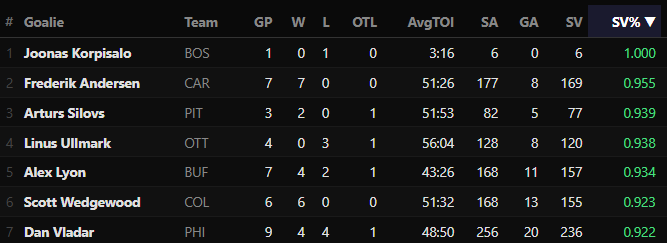
Start with what every analyst sees first. Carolina has allowed eight goals in seven games. That works out to a 1.14 goals-against per game. League-wide playoff scoring this postseason has been on the higher end, with several Wild-Avalanche games producing 9-6 and 5-2 results. Carolina is operating in a different sport.
Frederik Andersen, the 36-year-old Danish goaltender Carolina re-signed last summer when his career was supposed to be winding down, leads the entire postseason in goals-against average (1.02) and save percentage (.957). He is co-leading in shutouts with two. Per NHL.com, Andersen has now tied Cam Ward's 2006 mark for the longest postseason winning streak to open a playoff run by a goaltender born outside North America. Cam Ward, by the way, was a rookie when he made that run. He won the Conn Smythe. Andersen is doing it at 36.
This is not a hot streak from a backup who got hot at the right time. Andersen has been playing this way for the entire postseason. There is no statistical signal that suggests regression. He is simply playing the best playoff hockey of his career at the moment Carolina needed it most.
They Have Multiple Ways to Win
The deeper reason this team is different is what happens when the goaltending isn't the story.
In Game 1 against Philadelphia, Andersen recorded a 19-save shutout. That's the goaltending narrative. In Game 2, Carolina trailed 2-0 in the opening five minutes and won in overtime on a Taylor Hall goal. That's the resilience narrative. In Game 3, special teams decided it: two power-play goals from Jordan Staal and Andrei Svechnikov, plus a shorthanded goal from Jalen Chatfield. The Flyers went 0-for-5 on the power play. Different game, different formula, same result.
Coach Rod Brind'Amour summed it up after Game 3: "It's kind of been our calling card all year, whatever way the game kind of goes, I think we've been able to adapt to it and figure it out."
That's the part that matters most. Past Carolina teams under Brind'Amour have been one-dimensional in the wrong way. They generated shots at elite rates but struggled to convert them. They played the structure but couldn't execute the small-margin plays that decide playoff games. They had goaltending issues at the worst moments. This year's team has been all of those things at once, with the additional gift of a goaltender playing out of his mind.
The Hurricanes lead the postseason in time spent leading at 221 minutes and 47 seconds. That number is not luck. Teams that lead in playoff games are teams that scored first, played from ahead, and didn't have to chase. It is the cleanest single metric for "we are dictating play."
What Changed From Last Year
This is the part of the story that gets buried under the "Andersen is hot" headlines.
Carolina has been a top-tier regular-season team for six straight years. They have also been a team that exits the playoffs early or in disappointing fashion against the conference's top opponents. In 2023, the Florida Panthers swept them in the conference final and outscored them 13-3 in the process. The criticism that followed was structural: Carolina's system generated shots but generated the wrong kind of shots, didn't have a goaltender who could steal a series, and didn't have enough top-end skill to overcome those issues.
Two of those problems are now solved. Andersen, who was inconsistent in earlier playoff runs, is currently the best goaltender in the postseason. The shot-quality concerns have been less acute this year because Carolina is finishing at higher rates and converting the high-danger looks they generate.
The third problem, top-end skill, is being addressed differently. The Hurricanes haven't acquired a single dominant superstar. Instead, they have built depth that produces secondary scoring at every position. Logan Stankoven scored twice in Game 1. Taylor Hall delivered the Game 2 overtime winner. Nikolaj Ehlers, the offseason acquisition, scored the dagger in Game 3. The depth model is the antidote to the "we don't have a McDavid" problem. You don't need one player to win every shift if you have nine players who can win one.
The Sweep Is Almost Here, But It's Not the Story
Game 4 is at 6 p.m. ET in Philadelphia. The Hurricanes are heavy favorites and history is overwhelmingly with them. Per NHL.com, teams that take a 3-0 lead in a best-of-seven are 212-4 all-time, including 3-0 in the 2026 playoffs.
If Carolina wins, they get extended rest before the Eastern Conference Final. They become the first team to start a postseason 8-0 since the current format began. They give Andersen another four to five days to keep his form. They give the entire roster another four to five days to rest legs that are now seven games into a sprint.
If Philadelphia steals one, the series goes back to Carolina for Game 5 on Monday and the narrative shifts only slightly. The Hurricanes still have a 3-1 lead with home ice. The Flyers, whose own first-round comeback against Pittsburgh is the closest analog they can point to, are aware of how much one win can change the feel of a series. But the underlying truth wouldn't change. This Carolina team is operating at a level the franchise has not reached since 2006.
The Bottom Line
The Hurricanes are not playing well. They are playing differently. Different from past Carolina teams that ran into the same wall every spring, different from the rest of the 2026 playoff field, and different from the kind of team most people picked to come out of the East before the playoffs began.
The Eastern Conference Final is now an inevitability. The opponent will come from the Buffalo-Montreal series, where the Sabres just dropped Game 2 at home and now head to Montreal with the series tied at 1-1.
Whoever wins that series will face a Carolina team that has, over seven games, built the strongest case it can possibly build that this year is different. Whether the case holds up against a healthy Eastern champion will be a different question. For now, the Hurricanes have answered every question this postseason has asked them.
More analysis on LivingHockey News.