
May 10, 2026 · LivingHockey
Buffalo and Montreal Are Splitting a Series Their Stars Aren't Playing In
The Sabres and Canadiens are tied 1-1 heading to Game 3, but the series story isn't the stars. It's the second lines and depth scoring deciding everything.

The Buffalo Sabres and Montreal Canadiens head to Bell Centre tonight for Game 3 of the Eastern Conference Second Round, with the series tied 1-1. Buffalo took Game 1, 4-2. Montreal answered with a 5-1 rout in Game 2.
So far, this looks like a tightly competitive second-round series between two teams that won surprising first-round upsets. That part is true. What's stranger is the way the series is being decided. Through 120 minutes of playoff hockey between two of the highest-scoring top lines in the Eastern Conference, the actual top lines have been mostly invisible.
This is a series whose stars are not playing in it. The depth players are deciding everything.
The Top Lines Have Disappeared
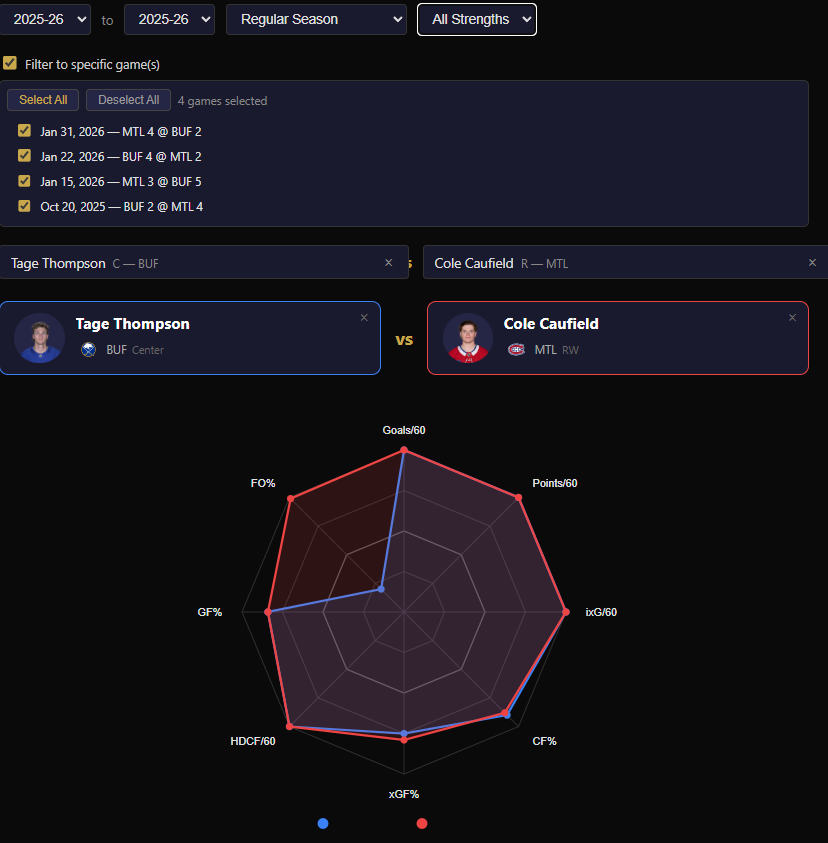
Start with Montreal. The Cole Caufield - Nick Suzuki - Juraj Slafkovsky line was one of the NHL's most productive units during the regular season. Caufield scored 51 goals. Suzuki captained the team to an Atlantic Division top-three finish. Slafkovsky has been the second-overall pick the Habs needed him to be.
Through eight playoff games, this line has scored exactly one even-strength goal.
Caufield, the 50-plus goal scorer, has one goal at 5-on-5 in the entire postseason and a minus-5 rating. He had no points and two shots in Game 1 of this series. Suzuki has been better but is still operating well below his regular-season output. Slafkovsky has found himself frequently disconnected from the play.
Buffalo's situation is not as dire but the pattern is the same. The Tage Thompson - Alex Tuch - Peyton Krebs line, which carried the Sabres for stretches of the regular season, played to what NHL.com described as "a standstill" when matched against Montreal's top line in Game 1. Thompson had no shot on goal in Game 1. He went minus-1 with no shots on goal in Game 2 and called his own performance "a disaster." His exact quote, after Game 2: "I just wasn't executing. Everything I touched turned into disaster tonight."
When the two best regular-season units on the ice combine for a single even-strength goal across 120 minutes of a playoff series, you would normally expect a 0-0 deadlock. Instead, both teams are scoring. The reason is that everyone else on the roster is scoring instead.
Game 1 Was a Buffalo Depth Showcase
Buffalo's 4-2 Game 1 win included one goal each from Josh Doan, Ryan McLeod, Jordan Greenway, and Bowen Byram. None of those four is a top-line forward. McLeod and Greenway are bottom-six energy players. Doan is a young winger acquired to fill out the lineup. Byram is a defenseman.
This is the kind of distributed scoring sheet that usually defines a series-clinching game, not a Game 1. And it happened with Thompson registering zero shots on goal.
The most telling individual performance might have been Zach Benson's. The 20-year-old, who extended a point streak to three games with five points (two goals, three assists), is the kind of player a team is supposed to develop into a top-six contributor. Buffalo is now relying on him to be one in real time. He has delivered.
Game 2 Was a Montreal Reshuffle Showcase
Game 2 looked like the inverse, but with the same underlying mechanic. Coach Martin St. Louis had reshuffled his lines late in the Tampa Bay series and landed on a new second unit: Alex Newhook with Jake Evans and rookie Ivan Demidov.
Newhook scored twice in Game 2. The first came 96 seconds into the first period. The second came on the rush in the second period, four seconds after a Sabres power play expired. Mike Matheson, Alexandre Carrier, and Suzuki added the others. The 5-1 rout was a statement.
Notice what's not in that summary. Caufield didn't score. Slafkovsky didn't score. The reshuffled second line, not the marquee top line, was the unit that won the game. Suzuki's goal came on the empty net.
Per St. Louis after Game 2, the Newhook unit "generated a lot 5-on-5 as well." This is a quote about the second line and it is an indictment-by-omission of the first.
What This Means for Game 3 and Beyond
Two possibilities exist heading into tonight.
The first possibility is that the top lines wake up. Caufield is too talented and too proud to disappear for a full second-round series. Thompson said himself after Game 2 that he has to be better. The numbers are extreme enough that some regression toward star-level production is likely. If the top lines start producing, this becomes a much different series, with both teams' offensive ceiling raising significantly.
The second possibility is that the depth pattern continues, and one team's depth is meaningfully better than the other's. This is the more analytically interesting outcome. Hockey series often reveal which roster has the deeper construction, not which one has the bigger star at the top. If Montreal's depth keeps scoring while Buffalo's doesn't, or vice versa, the series outcome will be a referendum on roster construction more than star performance.
Both teams have legitimate cases. Buffalo's depth is the result of a deliberate front-office push under new GM Jarmo Kekäläinen, who acquired Sam Carrick, Tanner Pearson, Logan Stanley, and Luke Schenn at the deadline explicitly to add bottom-six and bottom-four reinforcements. Montreal's depth is younger, more emergent, and reflects what happens when a team's prospect pipeline starts paying off at the same time. Both approaches work. They just look different.
The Bigger Picture for the Sabres
There is one more layer to this for Buffalo specifically. After ending the longest playoff drought in NHL history earlier this spring, the Sabres' first task was to win a playoff series. They did, eliminating the Boston Bruins in six games. Their second task is now the conference final. They are halfway to that, and the team's two longest-tenured players, Rasmus Dahlin and Tage Thompson, have not yet had their breakthrough playoff moment.
If Buffalo wins this series, it will likely be because either Thompson or Dahlin, or both, finally take over a game. If they don't, the question becomes whether a team this dependent on depth can sustain that style of win against a healthy Carolina Hurricanes team in the conference final.
Game 3 puck drop is at 7 p.m. ET in Montreal. Bell Centre is going to be loud. The series may be decided by a familiar face finally producing, or by another role player no one expected. So far, the second outcome has been the rule.
More analysis on LivingHockey News.