
May 9, 2026 · LivingHockey
The Quinn Hughes Trade Has Already Worked. Now It Has to Justify Itself.
The Wild's blockbuster Quinn Hughes trade ended an 11-year drought. Whether it justifies what they paid depends on what happens against Colorado.

The Minnesota Wild won a playoff series for the first time since 2015. They did it on the back of Quinn Hughes, who currently leads the entire postseason with 11 points in seven games. He scored two goals and added an assist in the Game 6 closeout against Dallas, including the eventual game-winner with 9:22 to play.
By any reasonable measure, the trade has worked. The drought is over. The 2024 Norris Trophy winner is the best defenseman to wear a Wild sweater since Ryan Suter. Bill Guerin made the boldest in-season acquisition in years and got the immediate result he was hoping for.
And yet, the conversation around this trade is just getting started. What the Wild paid, and what they still need to get out of Hughes to make it worth it, is a much higher bar than "advance past the first round."
What Minnesota Actually Gave Up
Let's be honest about the asset cost. Vancouver received Marco Rossi, Liam Ohgren, Zeev Buium, and Minnesota's 2026 first-round pick. Per ESPN, the package amounts to three former first-round selections and a fourth incoming first-rounder.
Rossi was the team's seventh-leading scorer at the time of the deal. Buium was the highest-rated defense prospect in the organization. Ohgren had a clear NHL future. Each of them, individually, is a player most front offices would build around. Together, they represent a five to seven year window of cost-controlled production that the Wild surrendered to acquire one player on an expiring deal.
The "expiring deal" part matters most. Hughes is signed through 2026-27, and then he is an unrestricted free agent. Minnesota can begin extension discussions on July 1. They cannot guarantee the conversation goes their way. Per the original trade reporting, there was no extension agreement included in the deal.
That's the deal in plain terms: three young, controllable assets and a high pick for, at minimum, a season and a half of one of the league's top three defensemen, with the upside being a long-term re-signing and the downside being a Stanley Cup Final or bust.
The Argument That It Already Worked
There's a reasonable case that what's already happened justifies the trade on its own.
Minnesota had not won a playoff series since 2015. They had not advanced past the second round since 2003. For a market with a passionate fanbase and a reputation as a hockey state, that drought wasn't just frustrating. It was beginning to define the franchise. Hughes' arrival changed the team's ceiling overnight. The Wild went from a likely first-round-and-out to a team with three players in the top five of postseason scoring.
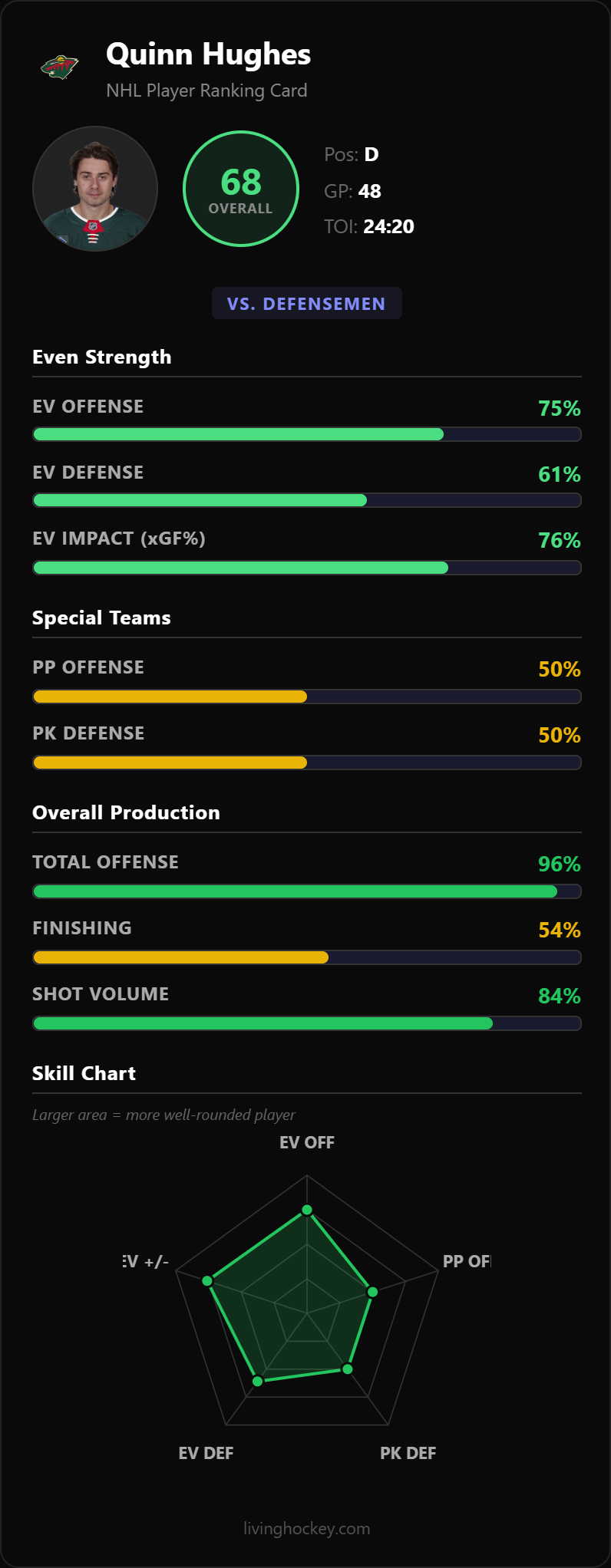
Coach John Hynes, talking to The Hockey News after Game 6, said the trade itself was as important as the player it returned: "Billy and Craig made the commitment to go after a player like Hughes and found a way to get him. I think it gave a huge vote of confidence in their belief in the team."
Trades of this scale aren't only roster moves. They're statements to the locker room and to the rest of the league. Minnesota wasn't waiting on the next draft class or hoping internal development would push them over the top. They were going.
From a fan-experience standpoint, the trade has already paid back something that doesn't show up in the cap sheet: the team is interesting again.
The Problem With "It Already Worked"
The problem is that "we made it interesting" is not the standard a roster like this should be measured against.
Look at what's happening right now. Minnesota dropped Game 1 of the second round and lost Game 2 by a 9-6 score in Denver, a game in which their offense kept pace but their defensive structure did not. The Avalanche are now favored at -200 to win Game 3. The series is not over. But Minnesota is staring at a 0-2 hole against the Presidents' Trophy winners with Cale Makar and Nathan MacKinnon on the other side.
If the Wild lose this series, the trade still has a runway. Hughes is under contract for next year. Minnesota retains a core of Kirill Kaprizov, Matt Boldy, and Brock Faber. They get another full offseason with Hughes in the building, and another full year to convince him to sign.
But every additional playoff round without a deeper run shifts the calculation. If 2026-27 ends without an extension and Hughes hits free agency, the Wild will have traded three young first-round-pedigree players and a top pick for two playoff appearances, one second-round exit, and a parting gift.
That's not a disaster. It's also not what this trade was made to produce.
The Real Test Is Round 2
The reason this series matters more than most: it's the round where the Hughes trade either becomes a foundational moment in franchise history or becomes a lesson about the cost of borrowing against the future.
A win over Colorado puts Minnesota in the conference final for the first time in 23 years. It strengthens every conversation about an extension. It justifies the asset cost on its own merits. Beating the league's best regular-season team is the kind of run that rewrites narratives.
A loss isn't fatal, but it changes the math. The Wild paid a clear premium, not just in players, but in pick capital that won't return for years. The longer they go without converting that premium into Stanley Cup-relevant outcomes, the more pressure builds on every subsequent move Guerin makes.
This is the structural reality of the NHL playoff format: you can't just be the team that ended the drought. You have to keep going. Round 1 wins fade quickly when Round 2 ends in five.
The Verdict
For now, the trade is a clear win. Hughes has been better than advertised. The drought is over. The market is engaged. The locker room got the message Guerin was sending.
But the actual verdict on this trade, the one that gets written in five years, will be decided over the next two weeks, and the next 18 months. If Minnesota beats Colorado, this becomes one of the great in-season acquisitions of the cap era. If they don't, it becomes a more interesting case study: about the cost of going all-in on a window, about the limits of even elite defensive talent against teams with elite offensive talent, and about the gap between making a statement and actually delivering on it.
The Wild aren't out of this series. But they are exactly where the Hughes trade was always going to be evaluated. Round 2 is the test.
More analysis on LivingHockey News.