
May 9, 2026 · LivingHockey
How the NHL Salary Cap Actually Works (And Why the League Just Closed a Loophole Worth Millions)
The NHL closed the LTIR playoff loophole this season. Here is how teams used long-term injured reserve to ice cap-illegal rosters, and what changes now.

For the last decade, one of the worst-kept secrets in the NHL was that the salary cap was not really a salary cap once the playoffs started. Teams that had carried cap-compliant rosters all season would suddenly ice lineups that, on paper, exceeded the cap by millions of dollars. The mechanism was legal, the practice was widespread, and the resulting championships were real.
Starting with the 2026 playoffs, that ends. As part of the new collective bargaining agreement signed last summer, the NHL and NHLPA agreed to implement a playoff salary cap a full season ahead of the new CBA's official start date. It is the most significant structural change to the cap system since the cap was introduced in 2005.
Here is how the cap actually works, what teams were doing to get around it, and why the league finally decided to act.
The Cap, in Plain English
The NHL operates under a hard salary cap. Each team has a maximum amount they can spend on player salaries in a given season, calculated based on a percentage of league-wide hockey-related revenue. For 2025-26, the cap is $95.5 million. The 2026-27 cap will rise to a record $104 million.
A team's payroll for cap purposes is calculated daily during the regular season under what the CBA calls the "Averaged Club Salary." It includes contracts on the active roster, injured reserve, buyouts, retained salary from trades, and a few other components. Go over the cap on any given day, and the team has a problem. The league's compliance system is automated and unforgiving in this regard.
The cap is the foundation of league parity. Without it, large-revenue teams could simply outspend smaller-revenue teams, and the structural balance the NHL has built since the 2004-05 lockout would collapse. That's the whole point.
But the cap had one giant exception, and that exception became a feature, not a bug.
Long-Term Injured Reserve, and How It Became a Tool
When a player is placed on Long-Term Injured Reserve, defined as being unfit to play for at least 24 calendar days and 10 regular-season games, his cap hit comes off the team's books for the duration of his injury. The team is permitted to spend up to the value of his salary in replacement players to fill the roster spot.
This is a reasonable rule. Teams shouldn't be punished for losing a star player to a serious injury. The intent is straightforward: keep teams competitive when they suffer a long-term loss they couldn't have planned for.
The problem is that the salary cap stopped applying once the playoffs began. Teams could exceed the cap in the postseason, full stop. There was no daily cap calculation for playoff games. There was no roster-value limit.
So if a team had a star player on LTIR all season, and that player happened to be ready to return right when the playoffs started, the team could:
- Use the LTIR cap relief during the regular season to bring in additional talent at the trade deadline.
- Activate the LTIR'd player for Game 1 of the playoffs.
- Ice a roster that combined the LTIR'd star and the deadline acquisitions, with a total cap value far above the regular-season limit.
This is not a hypothetical. It is exactly what multiple Stanley Cup contenders have done.
The Cases That Forced the Issue
Three cases in particular pushed the loophole into the spotlight.
Tampa Bay, 2020 and 2021. Nikita Kucherov underwent hip surgery before the 2020-21 season, was placed on LTIR for the entire regular season, and returned for the playoffs. The Lightning iced a roster valued at approximately $98 million during the playoffs against an $81.5 million regular-season cap. They won the Stanley Cup. They had also won the Cup the previous summer, in the Edmonton bubble, with a different LTIR situation. Critics referred to both rosters, particularly the second, as cap-illegal under any reasonable reading of the spirit of the rule.
Vegas, 2023. Mark Stone was placed on LTIR with a back injury in January 2023 and returned in time for the playoffs. The Golden Knights used the resulting cap space to acquire Ivan Barbashev at the deadline, then iced a roster well above the regular-season cap throughout the playoffs. They won the Stanley Cup. Stone scored a hat trick in the Cup-clinching game.
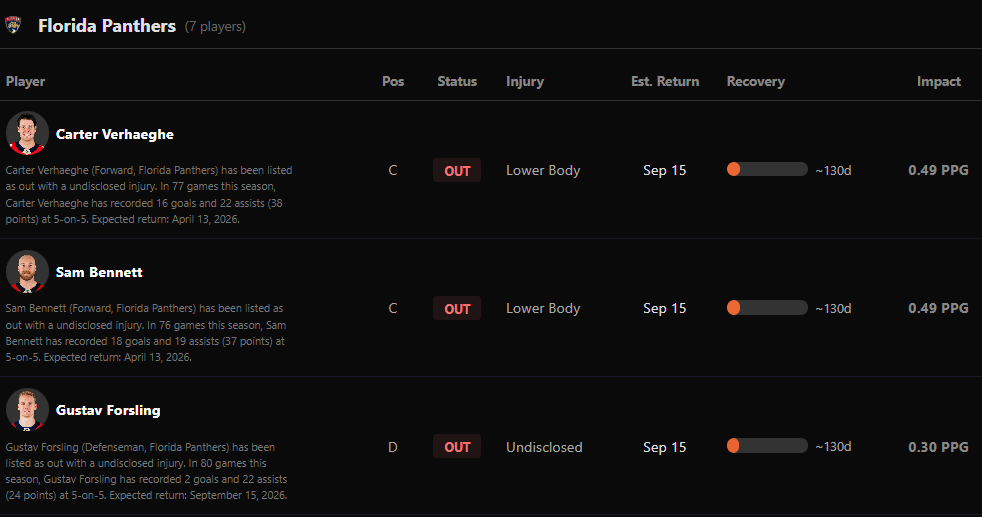
Florida, 2025. This is the case the new rule explicitly responds to. Per CapWages, Matthew Tkachuk was injured at the 4 Nations Faceoff and placed on LTIR. The Panthers used the full $9.5 million in resulting cap relief to acquire Seth Jones from Chicago and Brad Marchand from Boston. Tkachuk returned for the playoffs. Florida won the Stanley Cup, their second straight.
Three Cups in five years, all by teams that, at minimum, used the LTIR system in ways the original framers of the cap clearly did not intend. At some point, "loophole" stops being the right word and "feature" becomes more accurate.
What Changed
The new CBA introduces two related reforms. The first, the playoff salary cap, takes effect this postseason. The second, the LTIR relief cap, takes effect with the 2026-27 season.
The playoff salary cap. For each playoff game, a team must dress a lineup of 18 skaters and 2 goalies whose combined salaries do not exceed an "Averaged Club Salary" calculated for the playoffs. The components are calculated on a game-by-game basis, and adjustments are made for buyouts, retained salary, and over-35 contracts. The practical effect is that teams can no longer ice rosters in the playoffs that would have been cap-illegal in the regular season. A team with a $95.5 million regular-season payroll cannot dress $105 million worth of talent in Game 1 of Round 1.
The LTIR relief cap. Starting in 2026-27, teams placing a player on LTIR who intends to return that season or playoffs will be capped at $3.82 million in relief, regardless of the player's actual salary. The number is calculated based on the league's average salary from the previous year and will adjust annually. If a player is confirmed not to return for the season due to injury, the team can still replace the full cap hit, which preserves the rule's original intent.
Together, these two changes attack the loophole from both directions. Teams cannot accumulate the talent in the first place using full LTIR relief, and they cannot ice it in the playoffs even if they did.
What This Means for the 2026 Playoffs
The first practical test is happening right now. Teams that built their rosters expecting traditional LTIR flexibility are operating under a different rulebook in real time. There is no published list of which teams were specifically positioned to exploit the old rule this year, but the cap-watching community has been noting throughout the regular season which teams looked likely to have a "playoff bump" that won't materialize.
The competitive effect over the next several years is harder to predict, but the structural effect is clear. Three things will happen:
Trade deadline incentives change. Buyers will have less artificial cap room available, since they won't be banking on a healthy LTIR'd star giving them effective in-season space they can't use in the playoffs anyway. Deadline activity may compress.
Player health management changes. There has long been suspicion, never proven, that some LTIR placements were strategic in their timing. With $3.82 million as the new ceiling on in-season relief and a hard playoff cap, the financial incentive to keep a player on LTIR longer than medically necessary largely disappears.
Roster construction becomes harder for top-end teams. Teams that have stayed competitive while running cap-compliant rosters in the regular season will benefit relative to teams that have leaned on LTIR-driven flexibility. The competitive landscape will shift, even if slowly.
The Bottom Line
The NHL's salary cap was never really hard. It was a regular-season cap with a major exception, and that exception became one of the defining features of championship roster construction. Three of the last six Cup winners benefited from it in some form.
That era is over. The new playoff cap takes effect this postseason. The new LTIR relief limit takes effect next season. Whether the change produces more parity, fewer dynasties, or simply a different set of strategies remains to be seen. But for the first time in twenty years, the NHL salary cap actually means what it says.
More analysis on LivingHockey News.